

App Development: The Key Steps to Bringing Your App Idea to Life
Published at: October 15, 2026
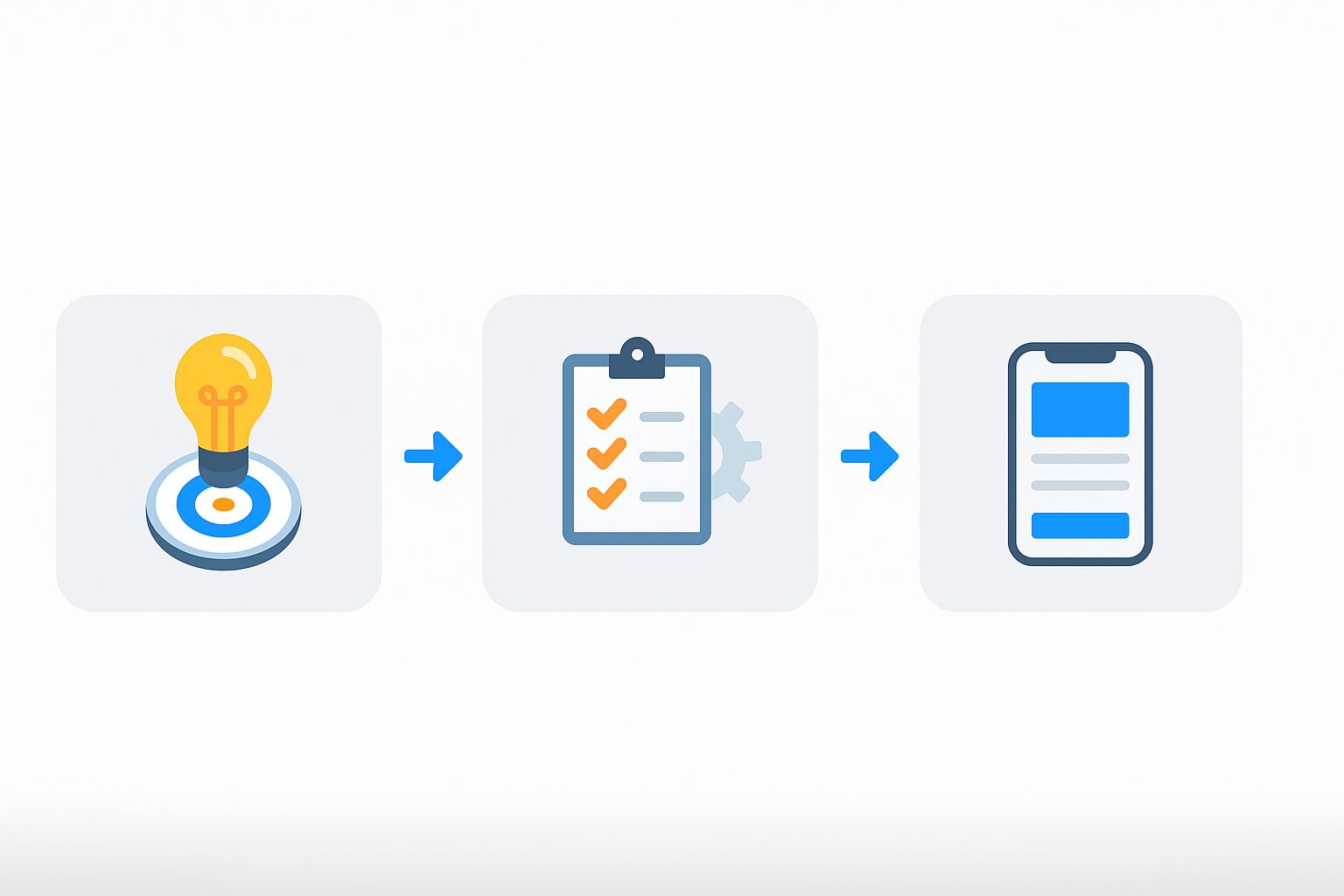
In this article, we’ll explore the first steps you should take when planning your company’s app development, ensuring a smooth and effective process. Bringing your idea to life can be exciting and a bit intimidating, especially if you’ve never done it before. However, you can navigate this process effectively with the right approach and plan. This article will guide you through the essential steps to develop an app that aligns with your business goals and meets user needs.
Where To Start: The Key Questions to Address Before App Development
Planning a coherent product blueprint results in a physical document, a Product Requirements Document – PRD. The Product Requirements Document (PRD) includes a detailed plan that answers all of the key questions at the pre-development stage, The purpose of the PRD is to create a solid foundation for a successful development process by answering questions focused on the key aspects of the app’s goals, such as the target audience, the functions required to meet the needs of your product and users, and more.
Answering these following questions will ensure a solid formula and framework that helps all of the stakeholders be on the same page on all critical issues and avoid any obscurity before moving to the development phase.
- What Problem Is Your App Aiming to Solve?
- Who Will Be Using Your App?
- What Are Your App’s Core Features & Functionalities?
- What Platforms Will Your App Be Available On?
- What Is the Expected Timeline for Development?
- What Budget Constraints Exist?
- How Will Success Be Measured (KPI)?
- What Are the Security and Compliance Requirements?
- What Are the Integration Needs with Other Systems?
- What Is the Long-Term Vision for the App?
What Problem Is Your App Aiming to Solve?
First, defining what is it that you want your users to gain by using your app, is fundamental. For example, a bank might develop an app to simplify the banking process for customers, providing them with real-time access to account balances, bill payments, and fund transfers. On the other hand, a coffee distribution company could create an app to streamline ordering, ensuring coffee shop owners and retailers receive their products efficiently. Defining the problem sets the stage for a practical, results-driven app that enhances your business goals.


Who Will Be Using Your App?
A clear understanding of your people, aka, the target audience – is crucial to building an app that resonates with its users. For a banking app, the primary users seek a secure and convenient way to manage their finances. Are the majority of users private customers, employees, or business owners? What is the age range of the users? Young people? adults? Business owners who want to manage their finances and their banking activities? On the other hand, a wholesale coffee distribution app will focus on end users such as business owners, retailers, and shop owners in the food service industry.
On the other hand, a coffee distribution app would focus on business owners and retailers in the food service industry. Knowing your audience’s preferences, pain points, and behaviors helps prioritize features and the design aspects, accordingly.
What Are Your App’s Core Features & Functionalities?
Before development begins, you’ll need to prioritize the app’s key functionalities. Defining the core, critical functions will allow us to focus on the first version of the application (The MVP – Minimum Viable Product). For a banking app, features would include viewing account balances, transferring funds, and receiving real-time alerts. A coffee distribution app, however, might include a product catalog, order tracking, and customer support communication. Identifying the must-have features ensures that the app delivers value right out of the gate.


Which Platforms Will Your App Be Available On?
Deciding which platforms to support—iOS, Android, or a web version—all affect the development approach. Supporting iOS and Android might be essential for a banking app to have a broader reach. However, a coffee distribution app might benefit from having a web platform that is easy for business owners who rely on desktops to use. The decision should be based on the place of activity of your target audience and the expected use of the application. The development is tailored to the desired capabilities and functions of the platform, such as push notifications for marketing purposes and more. This decision should be driven by where your target audience is most active and how they will use the app.
What Is the Expected Timeline for Development?
Setting a clear and realistic timeline is one of the most important steps in the app development process. For example, a bank may want to launch a mobile app within six months to coincide with a major marketing campaign, while a coffee distribution company might need a faster timeline to address immediate operational needs. Establishing a clear timeline allows you to map out key milestones and ensure timely app delivery.
What Budget Constraints Exist?
Every app development project involves budget considerations. A banking app, which requires advanced security and compliance features, may require a larger budget. On the other hand, a coffee distribution app may need to be more cost-conscious, initially focusing only on core functionalities. Understanding budget limits helps prioritize features, determine technology stacks, and allocate resources effectively.
How will you measure the success (KPI)?
Defining clear KPIs and success metrics is essential for evaluating an app’s effectiveness after launch. If we don’t know what success looks like or how to measure it, we won’t be able to reach it. Therefore, we need to define the triggers of use that we can define as a successful use of the application. For a banking app, for example, success could be measured through user adoption, transaction volume, customer satisfaction ratings, or saving time spent on managing customer communication. For a coffee distribution app, success might be measured by order volumes, user feedback, or delivery speed. Clear KPIs ensure that you can evaluate your app’s impact and make necessary adjustments.
What Are the Security and Compliance Requirements?
Ensuring the app meets industry regulations and security standards is non-negotiable, particularly for sensitive sectors like banking and medical-related apps. A banking or medical app, for example, must comply with strict financial regulations and use robust encryption to protect user data. Similarly, a coffee distribution app might need to meet food safety regulations such as FDA approvals and also ensure compliance with data protection laws. Addressing these requirements from the beginning prevents costly errors down the line such as the disclosure of users’ personal information and/or sensitive business information (data breaches) and will ensure trust in your brand.
Will Your App Need Integration with Other Systems?
Understanding how your app will integrate with existing systems is key to ensuring smooth operations. A banking app might need to integrate with core banking systems, payment gateways, and CRM software. A coffee distribution app, meanwhile, might need to interface with inventory management systems, point-of-sale systems, and logistics platforms. Identifying these integration needs ensures the app can function efficiently across different platforms.
What Is the Long-Term Vision for the App?
Finally, defining your app’s long-term vision is crucial for ensuring a product that is scalable and adaptable. This might mean adding new features such as investment tracking or a loan management system for a banking app. For a coffee distribution app, it could involve expanding product offerings or tapping into new markets. In the short term, retaining existing customers and increasing the volume of orders is a crucial goal. In the mid to long term, we would like to increase the number of customers and perhaps also expect to save on the high costs of resources (manpower, time, etc.).
What is PRD, The Foundation for Effective Development?
Understanding the Concept of Product Requirements Document (PRD): The Blueprint of App Development
Setting out to develop an app is a complex journey that requires strategic planning, just like building an office building or a home. While an architect’s blueprint dictates the specifics of a construction project, the Product Requirements Document (PRD) serves as a fundamental map for developing an app. It aligns business owners, developers, and designers with the app’s goals and functionalities.
Developing an app without a well-structured Product Requirements Document (PRD) can lead to misaligned expectations and scope creep. A poorly written PRD often increases development costs, extended timelines, and a final product that doesn’t meet the user’s needs. Implementing a comprehensive PRD promises that all stakeholders have a unified understanding of the process and an agreement that the final product will align with business objectives and user expectations.
So, What Is a Product Requirements Document (PRD)?
Understanding the concept of “Product Requirements Document (PRD)”: Your Blueprint for Product & Application Development Projects
The development of an application is a complex journey that requires strategic planning, much like constructing an office building or a house. Just as an architect’s blueprints and construction plans define the details of a building project, a Product Requirements Document (PRD), also known as a product specification document, serves as the foundation for application development.
This document acts as the cornerstone of the project and it’s written in a common language that aligns all stakeholders: entrepreneurs, business managers, product managers, marketers, designers, developers, and any people involved in the project.
Sticking to the analogy of an architectural plan, we want to know whether it’s a plan for a residential building or an office building, how many floors it will have, how many residential units or offices per floor, the type of soil the building will be built upon, whether special preparation is needed before construction, apartment specifications, and more. These two projects have different characteristics and uses, just as an application for a bank differs from an application for ordering wholesale coffee, and their specifications will differ accordingly.
A well-crafted, comprehensive PRD is the foundation and imperative for successful product development. Without it, you risk mismatched expectations, project scope creep, and outcomes that fail to meet user needs. Just as you wouldn’t construct a building without a plan, skipping the PRD stage can lead to costly mistakes, particularly in large and critical projects.
Even in simpler cases, such as building a small storage unit, a blueprint is essential—it ensures the structure serves its intended purpose and prevents future headaches, like having to move walls after construction. The same is true for a simple product such as a to-do list app. The saying “Plan a thousand times on paper, execute once” aptly reflects the critical role of a PRD.
As Abraham Lincoln famously said, “If I had eight hours to chop down a tree, I’d spend six sharpening my axe.” Writing a comprehensive PRD ensures that all stakeholders are aligned, development stays on track with business objectives, user expectations are met, and the project achieves success.
Writing a Product Requirements Document (PRD)
Preparing a PRD is essential for the pre-development phase. It outlines the application’s purpose and features (what functions it will include) and serves as a detailed roadmap for software development (front and back end). It helps ensure that every feature aligns with business objectives and meets user needs.
A PRD clarifies what is required from development—whether from UX designers or software engineers—by detailing technical requirements, performance metrics, and user expectations. This reduces the risk of costly errors and delays.
The Critical Importance of a Well-Structured PRD Before Development Begins
A finely structured PRD is crucial before coding or design work begins. Think of it as laying the foundation for a house—it ensures that everyone involved in the project knows what the end product will include and what it will look like. Without a comprehensive PRD, confusion is bound to happen, which can lead to delays, unexpected costs, and a final product that doesn’t meet its intended purpose. The PRD helps set clear expectations, guide decisions, and track progress from start to finish.
To illustrate the importance of a PRD, let’s recap our two examples: developing an app for a bank and a coffee distribution company.
Case Study #1 Summary: Developing a Banking App
The PRD for this project would cover essential features like account management, real-time notifications, and fund transfers. Security and compliance are top priorities, with the app designed to adhere to financial regulations and ensure robust encryption. An intuitive interface makes it easy for users of all ages to navigate, and a clear timeline and budget keep the project on track. In this example, the PRD is crucial in aligning all of these considerations, keeping the stakeholders informed on the vision, and ensuring the bank meets all the objectives they set out to reach.
Case Study #2 Summary: Developing a Coffee Distribution App
Now, consider a coffee distribution company aiming to create a web app to streamline operations. In this example, a specification is required for a web application to manage a coffee distribution system. This is a multi-user application involving a central distribution center, couriers, salespeople, suppliers, and customers. Given the system’s complexity and wide range of functionalities, we approach the specification using a scenario-based method: mapping all possible scenarios in the software.
For instance, one scenario might involve a customer paying for coffee, which triggers an order in the system. Another might involve a distribution center employee viewing open orders, creating packages, and assigning them to couriers. This helps us identify all necessary actions and the screens required to operate them. The specification will focus on the various actions and how they integrate into a coherent, intuitive, and user-friendly system, including real-time notifications for all users.
Conclusion: The Role of a PRD in App Development
In conclusion, a well-structured, well-planned, and comprehensive Product Requirements Document (PRD) is essential to the pre-development process. It is a blueprint outlining the goals, features, and technical requirements needed to align stakeholders and guide development. Businesses can ensure that their app meets user expectations and business goals by addressing key questions about objectives, target audience, and success metrics. With a clear PRD, the development process is smoother, more efficient, and more likely to result in a successful product.
To maximize your app’s potential, dive deeper into our upcoming article that provides a comprehensive guide to writing a winning PRD, ensuring your project aligns with both business objectives and user needs.
 Tags:
Tags:
- app development
- Product Requirements Document,
- PRD
- mobile apps
- software development


Need expert advice?
We'd love to hear about your challenge and propose a tailored solution.
Let's Talk
Leave a comment