
Custom CRM Development: Build a CRM That Actually Fits Your Business
Why off-the-shelf CRM fails fast-growing companies — and how a custom-built CRM with deep integrations changes everything
Published at: October 15, 2026
Why Most CRMs Fail Growing Companies
You bought Salesforce, HubSpot, or Pipedrive. The sales team got excited for about two weeks, then quietly went back to spreadsheets. Sound familiar?
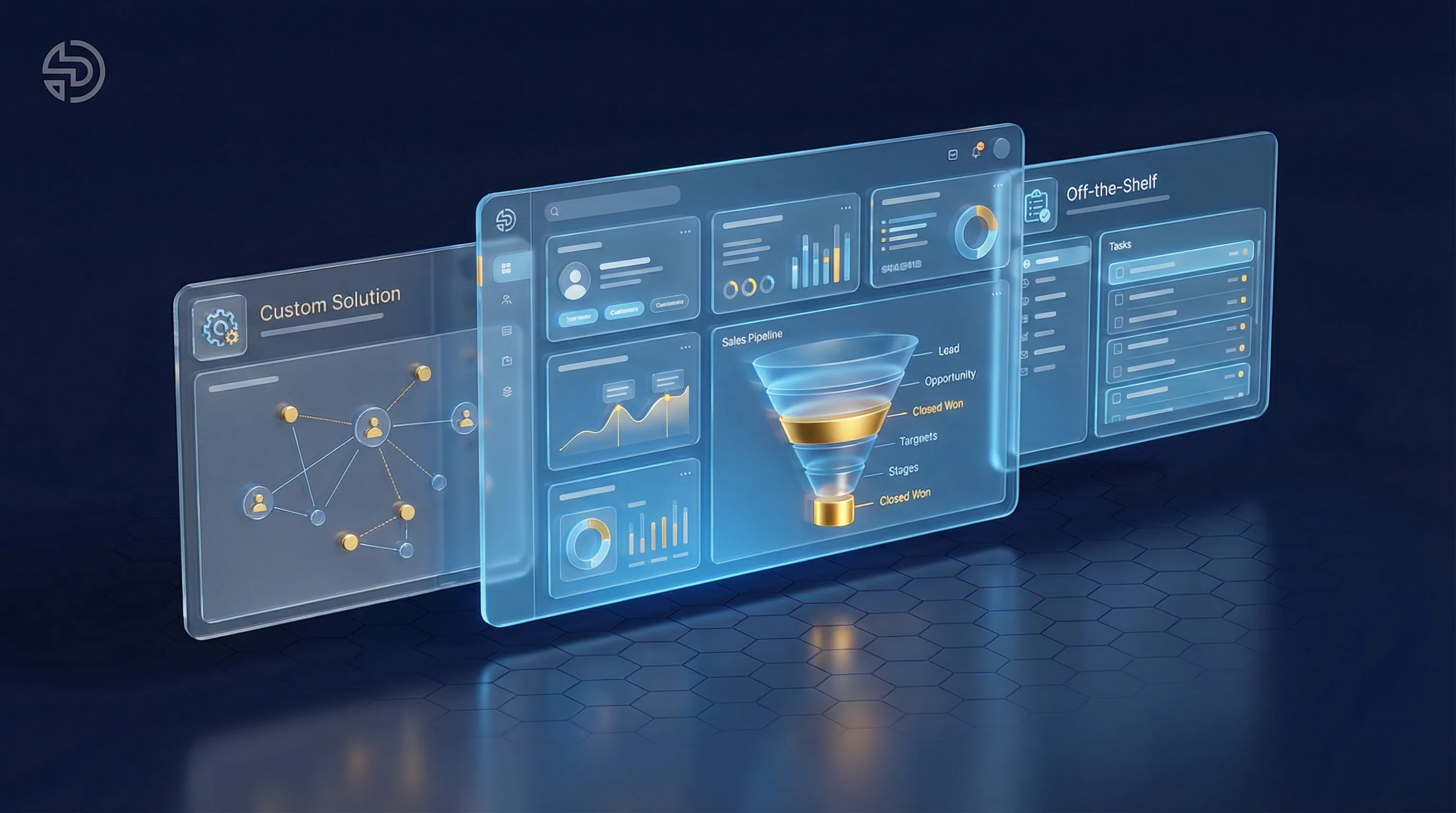
Off-the-shelf CRM platforms are built for the broadest possible audience. That means compromises everywhere: fields you don't need, missing integrations your ops team relies on, workflows that don't match how your team actually sells.
Custom CRM development solves this at the root. Instead of forcing your business to adapt to software, you build software that adapts to your business — your exact sales stages, your ERP system, your approval flows, your reporting needs.
What Is Custom CRM Development?
Custom CRM development means building a CRM system tailored specifically to your organization's sales process, data structure, and technology stack. This can mean:
- Building on a flexible platform like monday.com, Airtable, or Salesforce with custom configuration and development
- Integrating deeply with your existing ERP system — Priority, SAP, NetSuite, or others
- Developing entirely custom CRM software from scratch for unique or complex requirements
- Migrating from a legacy CRM and redesigning the architecture along the way
The goal is always the same: a CRM your team actually uses, because it fits how they work.
When Does a Business Need Custom CRM Development?
Not every company needs a fully custom CRM. But there are clear signals that off-the-shelf won't cut it:
1. Your Sales Process Is Complex or Non-Standard
If your sales cycle involves multiple stakeholders, custom approval flows, complex deal structures (project-based pricing, bundles, subscriptions), or long enterprise sales cycles — standard CRM pipelines break down quickly. Custom CRM development lets you model your process precisely.
2. You Need Deep ERP Integration
For companies running Priority ERP, SAP, or similar systems, the gap between CRM and ERP is a daily operational headache. Orders placed in the CRM need to flow into Priority automatically. Customer credit limits need to be visible to sales reps. Invoices generated in Priority need to update deal statuses in the CRM.
This level of bi-directional ERP integration is impossible with out-of-the-box CRM tools. Custom CRM development makes it seamless.
3. Your Team Manages Multiple Data Types
SaaS companies often need to track subscription status, feature usage, and renewal dates — not standard CRM fields. Field service companies need to link deals to job sites and technician schedules. Custom CRM development handles these mixed data models elegantly.
4. You Have Compliance or Security Requirements
Industries like fintech, healthcare, and legal often have strict data residency or access control requirements. Custom CRM development ensures your customer data is stored, processed, and accessed according to your specific compliance rules.
CRM Development Platforms: Choosing the Right Foundation
At UIDB, we don't push a single CRM platform. We evaluate your requirements and recommend the best foundation for your needs:
monday.com CRM Development
monday.com is our most frequent recommendation for mid-market companies. Its flexible data model, visual pipelines, and powerful automation engine make it an excellent foundation for custom CRM development. We build custom monday.com apps, deep automations, and integrations that turn the platform into a fully tailored CRM.
Best for: Teams of 10–200 people, workflow-heavy sales processes, companies already using monday.com for project management.
Salesforce Custom Development
Salesforce is the right choice when you need enterprise-grade scale, complex permission models, or an ecosystem of Salesforce-native integrations. We build custom Salesforce objects, flows, Apex triggers, and integrations that go far beyond what Salesforce admins can configure.
Best for: Enterprise sales organizations, complex multi-product companies, companies needing Salesforce's marketplace ecosystem.
Airtable CRM Development
Airtable's flexible database model is excellent for companies with non-standard data structures. We build Airtable CRM systems with custom automations, external integrations, and interfaces that work as full-featured CRM applications.
Best for: Startups, agencies, companies with creative or project-based sales models.
Fully Custom CRM Software
For organizations with requirements that no platform can meet — unique data models, real-time processing needs, or regulatory constraints — we build CRM systems from scratch using modern web technologies. These are purpose-built applications that own no licensing costs and can evolve precisely as your business grows.
Best for: Fintech, regulated industries, companies with very large data volumes or unique technical requirements.
The UIDB Custom CRM Development Process
Building a CRM that gets adopted requires more than writing code. Here's how we approach every custom CRM project:
Step 1: Sales Process Audit
We start with a deep dive into your current sales workflow. We interview sales reps, managers, and operations teams. We map every step from lead generation to deal closure — and everything that happens after the deal is signed.
This audit surfaces the bottlenecks, manual steps, and data gaps that a new CRM needs to solve.
Step 2: Platform Selection & Architecture
Based on the audit, we recommend a platform and design the data architecture. This means defining your pipeline stages, data model, user roles, automation rules, and integration points. We plan the ERP integration from day one — not as an afterthought.
Step 3: Build & Integrate
We build your CRM with all planned integrations: ERP sync, email, payment systems, communication tools. Every integration is tested with real data. We use staging environments to validate the system before it touches production data.
Step 4: Launch, Train & Optimize
We run hands-on training sessions with your team and launch in phases to minimize disruption. Post-launch, we monitor adoption closely and optimize based on real usage. As your business grows, we add features, new integrations, and reporting capabilities.
CRM and Priority ERP Integration: A UIDB Speciality
One of our most requested capabilities is Priority ERP integration with CRM systems. Priority is Israel's leading ERP system, used by thousands of companies — and its native CRM capabilities are limited.
We build real-time bi-directional sync between your CRM (on monday.com, Salesforce, or custom) and Priority ERP, covering:
- Customer and contact synchronization
- Quote and order flow from CRM to Priority
- Invoice status and payment updates back to CRM
- Credit limit checks visible to sales reps in real time
- Inventory availability lookup during deal creation
This integration eliminates double data entry, reduces errors, and gives your sales team full visibility into operational status — without leaving their CRM.
Custom CRM Development: What Does It Cost?
CRM development costs vary widely based on complexity, platform choice, and integration requirements. Here's a rough guide:
- CRM on monday.com or Airtable (with automations and basic integrations): 4–8 weeks
- Salesforce custom development (custom objects, flows, complex integrations): 8–14 weeks
- Custom CRM software from scratch (unique requirements, complex data models): 12–24 weeks
- ERP integration add-on (Priority, SAP): adds 2–6 weeks depending on scope
Every project starts with a free consultation where we scope your requirements and provide an honest estimate.
Why Choose UIDB for Custom CRM Development?
UIDB is a boutique R&D software company. We're not a Salesforce reseller or a monday.com implementation mill. We're software engineers who have built CRM systems across industries — fintech, real estate, manufacturing, SaaS, retail, and more.
We treat every CRM project as a long-term partnership. We invest in understanding your business deeply, because CRM systems that don't reflect real workflows fail — no matter how technically impressive they are.
As an official monday.com partner and experienced Priority ERP integration specialists, we're uniquely positioned to build CRM systems that connect the front office (sales) to the back office (operations) seamlessly.
Frequently Asked Questions About Custom CRM Development
How long does custom CRM development take?
A CRM built on monday.com or Airtable typically takes 4–8 weeks. A Salesforce custom build takes 8–14 weeks. A fully custom CRM with complex ERP integration can take 12–20 weeks. We always deliver in phases so your team can start using the system early.
Can you migrate data from our existing CRM?
Yes. We handle complete data migration from any existing system — spreadsheets, legacy CRMs, or modern platforms. We clean, map, and validate all data before importing to ensure accuracy and a smooth transition.
Do you support the CRM after launch?
Yes. We provide ongoing development, maintenance, and optimization as your business evolves. We're not a project shop — we're a long-term technology partner.
Do you design the UI/UX for a custom CRM, or just build the backend?
Both — and we treat them as one project, not two. A custom CRM that your sales and ops teams actually adopt needs UI/UX design built around how your team really works, not a generic template. Our custom CRM development includes dedicated UX/UI design: workflow mapping, information architecture, and interface design before a line of code is written, so the data model and the screens your team uses every day are designed together.
Contact us for a free consultation on your custom CRM project
 Tags:
Tags:
- custom crm development
- crm software development
- crm development company
- custom crm software
- salesforce integration
- monday.com crm
- priority erp integration
- airtable crm
- crm ui/ux design
- custom crm ui/ux


Need expert advice?
We'd love to hear about your challenge and propose a tailored solution.
Let's Talk
Leave a comment